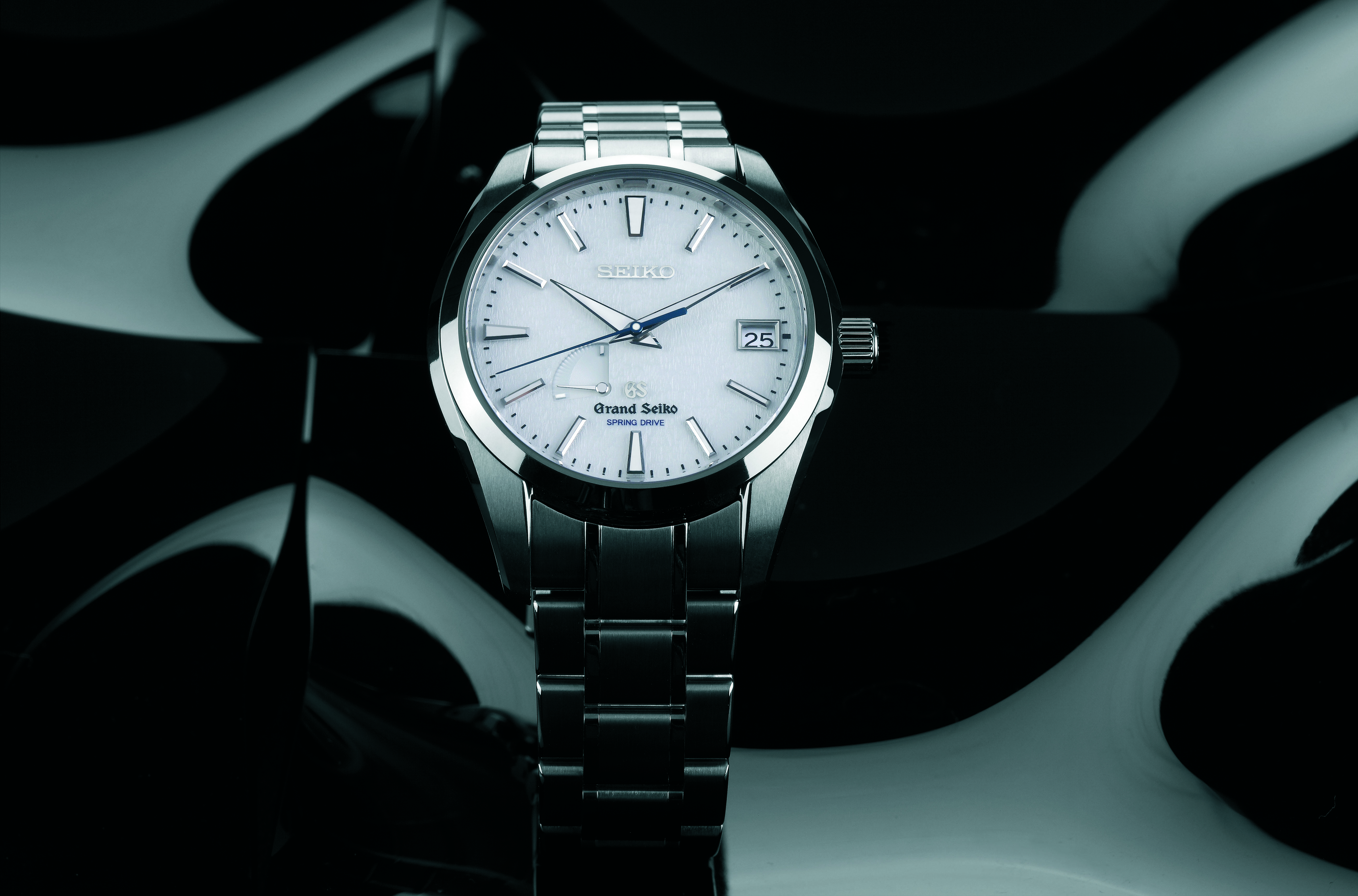
The first thing you notice about the Snowflake is the dial. The textured white surface, meant to evoke the snow-covered landscape visible from Grand Seiko's Shinshu Watch Studio in Nagano Prefecture, is not stamped or printed. It is a multi-layered finish achieved through a process that Grand Seiko keeps deliberately vague. The result is a surface that shifts between bright white and cool silver depending on the light angle, with subtle undulations that suggest terrain rather than machinery.
This attention to dial craft is characteristic of Grand Seiko's approach. Where Swiss brands often distinguish themselves through movement architecture and complication, Grand Seiko competes through surface finishing. The Zaratsu polishing technique — a method of achieving distortion-free mirror surfaces on case flanks — produces reflections so clean that the polished surfaces appear to be made of liquid metal. The contrast between brushed and polished elements on a Grand Seiko case is sharper than on any Swiss watch at comparable prices.
Spring Drive: The Third Way
The Snowflake (ref. SBGA211) is powered by the Spring Drive caliber 9R65. Spring Drive is neither mechanical nor quartz — it is a hybrid technology invented by Seiko engineer Yoshikazu Akahane, who spent 28 years developing the concept. A mainspring stores energy (mechanical). A gear train transmits it (mechanical). But the regulating organ is an integrated circuit that uses the electrical current generated by a tiny rotor to control the speed of the gear train electromagnetically. The accuracy is ±1 second per day — better than any purely mechanical movement and close to quartz.
Watch the Snowflake's seconds hand sweep around the dial without ticking, without stuttering, in one continuous motion — and you are seeing a movement technology that literally no other company on Earth produces.
The visual result of Spring Drive is the glide motion of the seconds hand. Mechanical watches tick at their beat rate (typically 6, 8, or 10 ticks per second). Quartz watches tick once per second. The Spring Drive seconds hand sweeps in a smooth, unbroken arc. It is mesmerizing to watch, and it immediately communicates that something different is happening inside the case. For many owners, this glide motion alone justifies the purchase.
The Complete Picture
At 41mm in diameter and 12.5mm thick, the Snowflake wears comfortably on most wrists. The titanium case and bracelet give it a lightness that contradicts its visual presence. The power reserve indicator at the eight o'clock position is the only sub-dial, and it integrates cleanly into the dial layout. The date window at three o'clock uses a color-matched date wheel that blends with the snowfield texture. These are small details, but they accumulate into an impression of thoroughness.
Grand Seiko priced the Snowflake below $6,000 at retail — a figure that becomes increasingly difficult to comprehend as you examine the watch's finishing, movement technology, and case construction. Comparable Swiss watches cost two to four times as much. This value proposition is Grand Seiko's most potent competitive weapon, and the Snowflake is its sharpest expression. It is, simply, more watch per dollar than almost anything else available.
The Swiss industry has largely ignored Grand Seiko, which is understandable from a competitive standpoint and increasingly difficult to justify from a qualitative one. The Snowflake does not need Swiss validation. It has its own movement technology, its own finishing philosophy, its own design language, and its own deeply loyal following. It is Japan's quiet rebuttal to the assumption that fine watchmaking belongs to any single country.