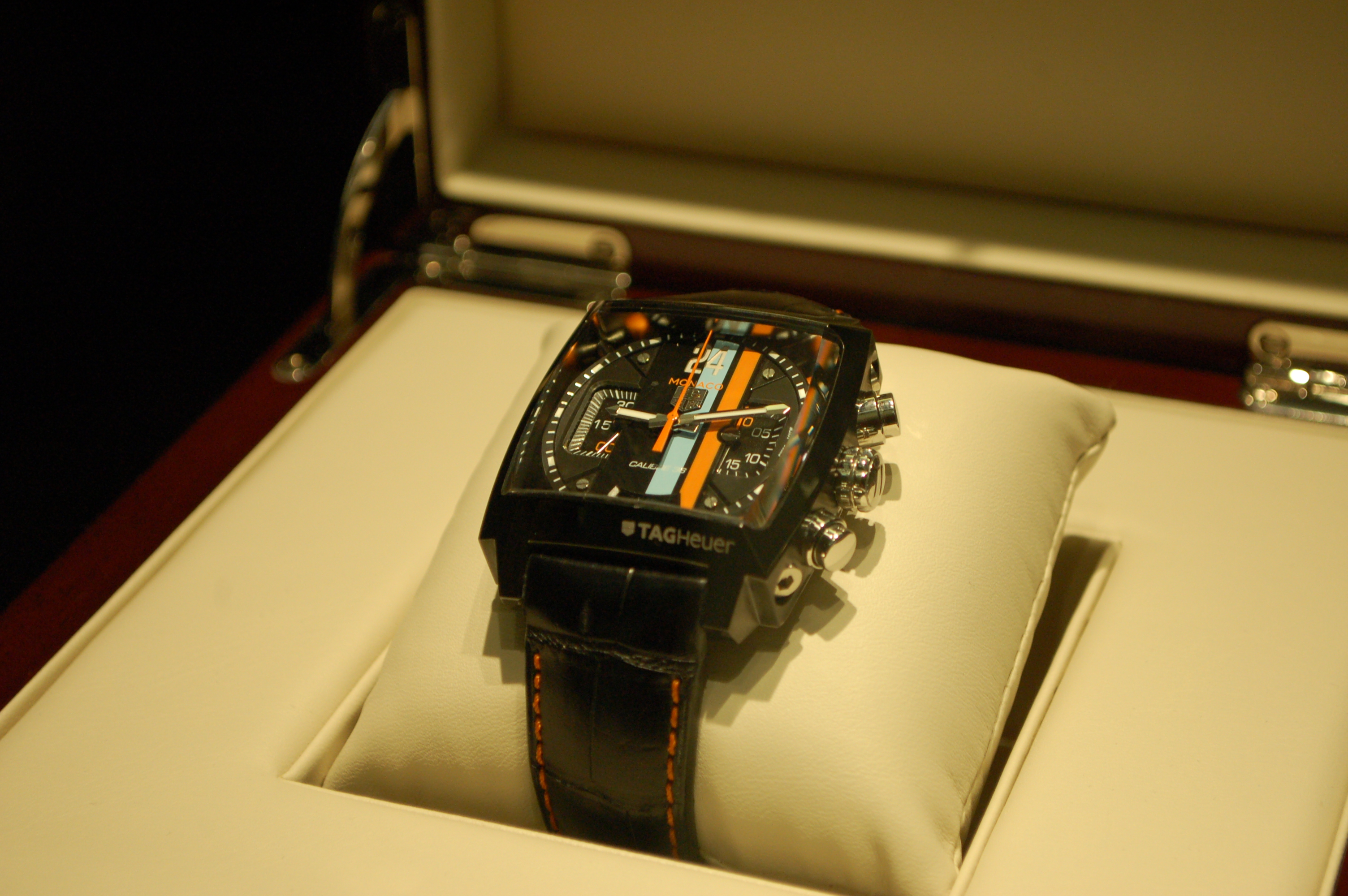
The Monaco was never supposed to be a classic. When Heuer (the 'TAG' came later) introduced it in 1969, the watch industry operated on a set of assumptions so deeply held they were invisible: watches were round, crowns were on the right, and blue dials were for diving watches. The Monaco violated all three. Its square case measured 40mm — huge for the era. The crown sat at nine o'clock, a consequence of the automatic Calibre 11's architecture. And the blue dial, paired with white sub-registers, had no connection to any established genre.
The Calibre 11 movement inside was one of the first automatic chronograph movements, developed by the Breitling-Heuer-Hamilton-Buren consortium with Dubois Dépraz. Its microrotor design allowed the movement to be thinner than a centrally-mounted rotor would permit, contributing to the Monaco's relatively slim profile. The left-side crown was a direct result of the movement's winding mechanism — function dictating form in a way that created a signature design element.
Le Mans and McQueen
In 1970, Steve McQueen wore a Monaco on set during the filming of Le Mans. The movie was a commercial failure. The watch's cultural trajectory, however, was set permanently. McQueen — the definition of American masculine cool in the 1970s — wearing this strange, square, blue chronograph on a racing circuit: the image was powerful enough to override the watch industry's indifference to the Monaco's unconventional design. You cannot buy the kind of association that McQueen gave this watch.
The Monaco is not a beautiful watch in the classical sense. It is a striking watch — and in the economy of style, striking outlasts beautiful nearly every time.
After the initial production run ended in the 1970s, the Monaco went through various reissues and special editions, some more successful than others. The dark years involved quartz movements and modified case shapes that diluted the original's impact. TAG Heuer's current approach — faithful to the original proportions and colorway while updating the movement — is the correct one.
The Contemporary Monaco
Today's Monaco (ref. CBL2111) houses the Heuer 02 automatic chronograph movement, an in-house caliber with 80-hour power reserve and column wheel. The 39mm case maintains the original proportions. The blue sunray-brushed dial retains the two-register layout with contrasting sub-dials. The crown remains at nine o'clock. These are not just design choices — they are acts of loyalty to the original vision, and they matter because the original vision was correct.
The Monaco will always be a polarizing watch. Its square case rejects the wrist-hugging conformity that round watches offer. It sits on the wrist like a statement, not a whisper. Some people will never warm to it, and that is part of its function — the Monaco selects for a certain kind of wearer, one who is comfortable with conspicuousness. In an industry full of safe choices, the Monaco remains a fundamentally unsafe one. That is why, fifty-five years after its debut, it still feels vital.