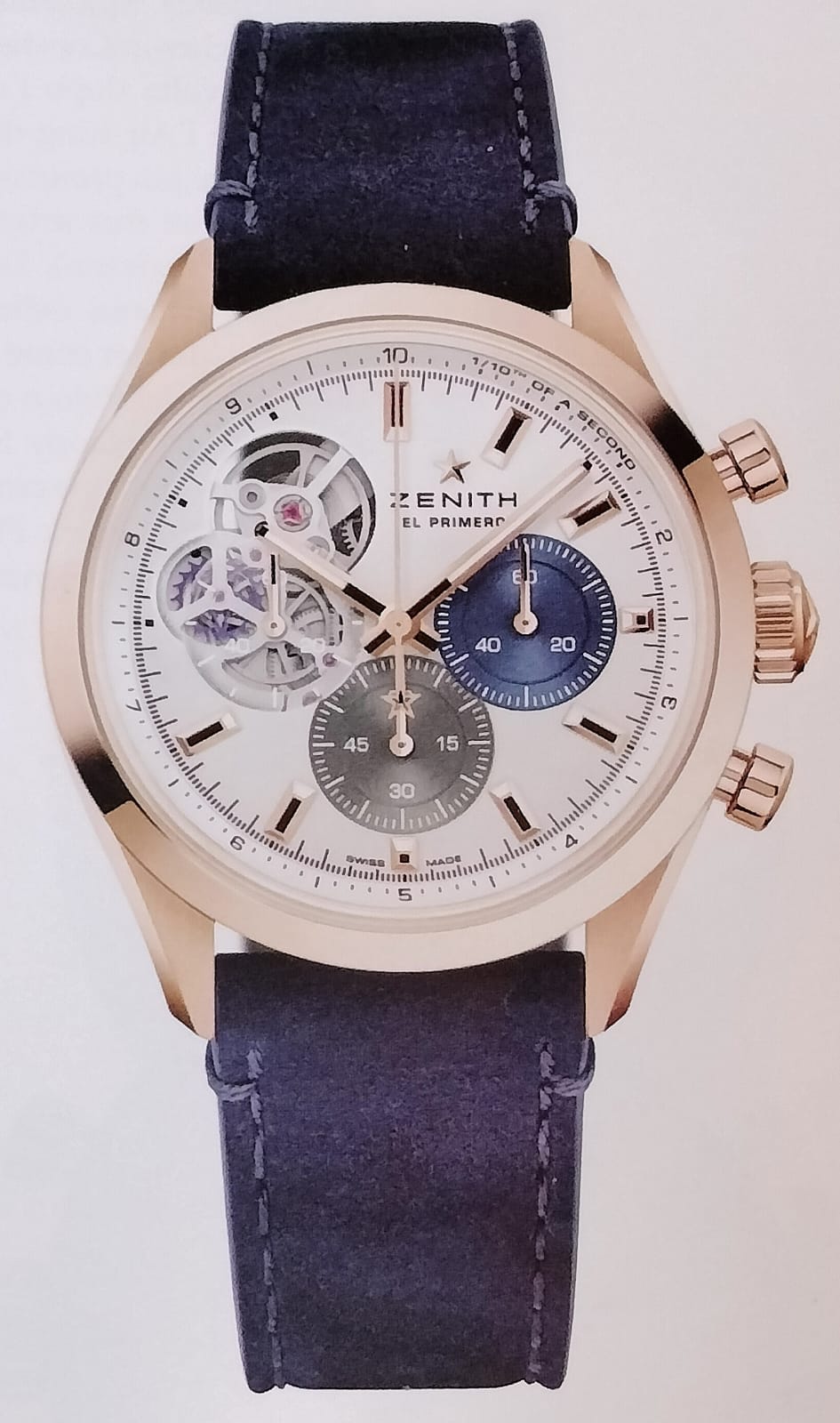
The race to build the first automatic chronograph movement in the late 1960s was one of watchmaking's great sprints. Three groups were competing: Zenith in Le Locle, a consortium of Breitling-Heuer-Hamilton-Buren with Dubois Dépraz, and Seiko in Japan. On January 10, 1969, Zenith unveiled the El Primero caliber 3019 PHC — a high-frequency (36,000 vph) integrated automatic chronograph that could measure elapsed time to one-tenth of a second. It was, depending on which brand's PR department you consult, either the first or among the first automatic chronograph movements ever produced.
What is not disputed is the El Primero's technical ambition. Running at 36,000 vibrations per hour — significantly faster than the standard 28,800 vph — it offered genuine timing precision that competitors could not match. The integrated architecture (as opposed to a modular approach where a chronograph module sits atop a base movement) allowed for a thinner profile. The tri-color sub-dial layout — typically blue, light gray, and charcoal — became instantly recognizable.
The Attic
Then the quartz crisis arrived and nearly destroyed Swiss mechanical watchmaking entirely. By the mid-1970s, Zenith's American owners ordered the company to stop producing mechanical movements and focus exclusively on quartz. The instruction included destroying the El Primero's tooling, dies, and presses — everything needed to produce the movement. Watchmaker Charles Vermot, unable to accept this order, secretly dismantled the production equipment and hid it in the attic of the manufacture, behind a false wall.
Charles Vermot's act of preservation was not corporate strategy. It was the instinct of a craftsman who understood that some things, once destroyed, cannot be rebuilt from memory alone.
When the mechanical watch market recovered in the 1980s, Zenith retrieved Vermot's hidden cache and resumed El Primero production. The movement was so well-regarded that Rolex selected it as the base for the Daytona's automatic caliber 4030, used from 1988 to 2000. Having your movement chosen by Rolex is perhaps the ultimate validation for a Swiss manufacture.
The Modern El Primero
Today's El Primero family includes the Chronomaster collection, which showcases the movement's high-frequency capability through open-worked dials that expose the escapement. The Chronomaster Sport, with its signature tri-color registers and ceramic bezel, is Zenith's flagship. The Defy collection offers a more contemporary, angular interpretation. Both lines house descendants of the original 3019, now designated as caliber variants in the El Primero 3600 family.
Zenith has also pushed the El Primero architecture to extremes. The Defy 21 operates at 360,000 vph — ten times the original frequency — allowing it to measure time to one-hundredth of a second. It achieves this through two escapements running at different frequencies: one for timekeeping and one for the chronograph function. It is a technical statement that no other brand in Zenith's price range can match.
The El Primero's survival story gives it a narrative weight that transcends specifications. This is a movement that was sentenced to death and saved by a single watchmaker's conscience. Every El Primero produced today exists because Charles Vermot decided that craft was more important than a corporate directive. That is not a marketing story — it is a moral one, and it makes the El Primero perhaps the most emotionally resonant movement in all of watchmaking.