The Nautilus was an insult before it was an icon. In 1976, Patek Philippe was the undisputed patriarch of high horology — a house defined by precious metals, enamel dials, and complicated dress watches. When Gérald Genta proposed a large steel sports watch with an integrated bracelet, the concept must have felt like vandalism. Steel was for Seiko. Steel was for the masses. Steel was not for the firm whose motto proclaimed 'You never actually own a Patek Philippe.'
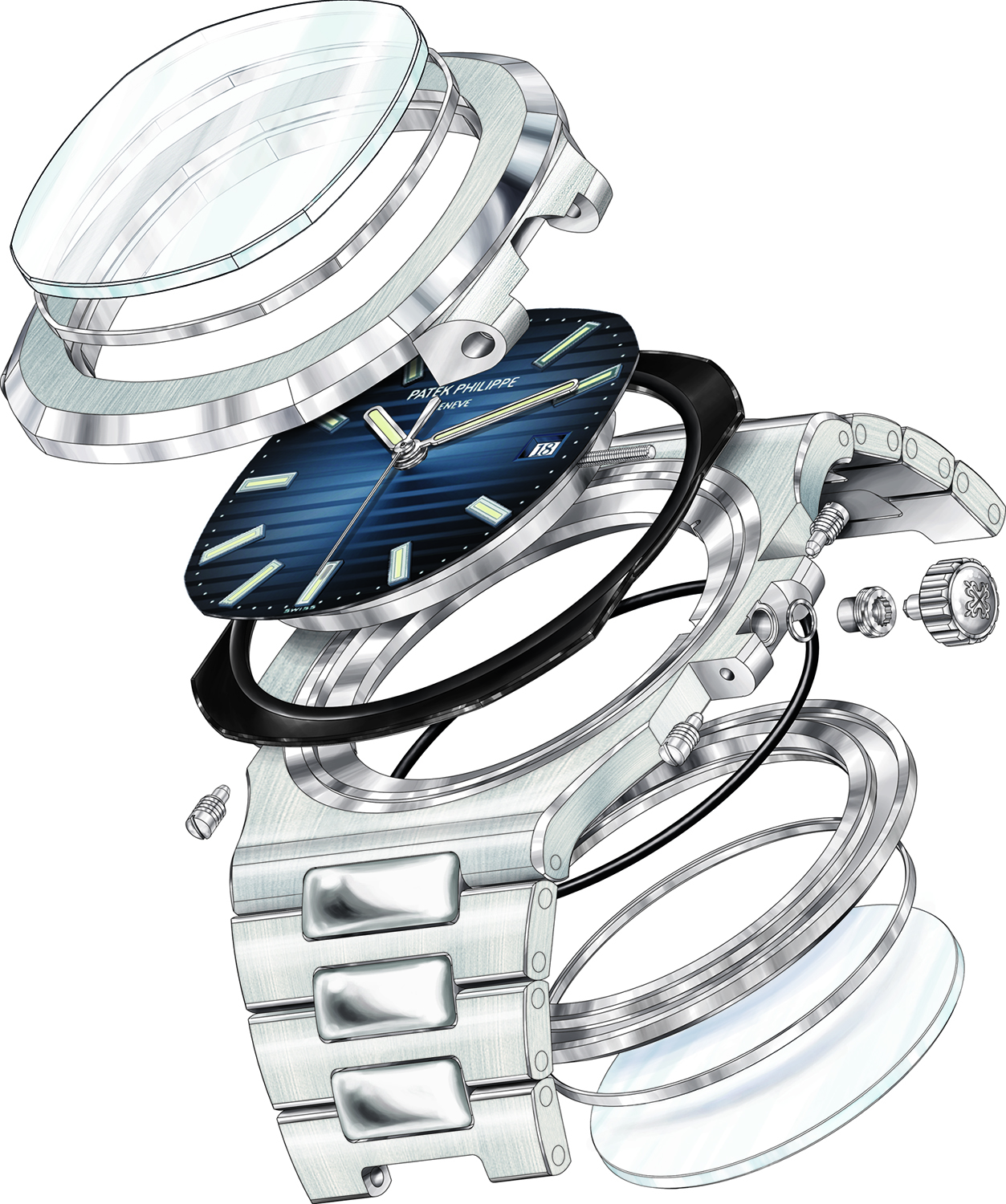
Genta, of course, had already performed a similar act of heresy for Audemars Piguet with the Royal Oak four years earlier. The Nautilus shared the Royal Oak's philosophical DNA — expensive metal, integrated bracelet, thin profile — but softened the geometry. Where the Royal Oak was angular and confrontational, the Nautilus was rounded and organic. Its case shape, inspired by a ship's porthole, had ears that folded over the bezel like parentheses around a thought.
Reference 5711: The Center of Gravity
For most of its life, the Nautilus was a respected but not particularly hyped member of the Patek catalog. That changed with the reference 5711/1A, introduced in 2006. This three-hand, date-only version in steel became the focal point of a market frenzy that defied rational pricing. By 2021, when Patek announced the discontinuation of the olive-green-dialed 5711/1A-014, secondary market prices had already tripled beyond retail. The final Tiffany Blue edition, limited to 170 pieces, sold at auction for over $6.5 million.
The Nautilus is not priced according to material cost or movement complexity. It is priced according to what people will endure to own one — and that turns out to be quite a lot.
The economics of the Nautilus are a case study in manufactured desire. Patek Philippe produces relatively few pieces. Authorized dealers allocate them to established clients with significant purchase histories. The secondary market fills the gap at a substantial premium. This creates a self-reinforcing loop: scarcity generates desirability, desirability inflates prices, inflated prices confirm the watch's status, and status intensifies demand. Whether this is a healthy dynamic for horology is debatable. That it is effective is not.
Beyond the Hype
Handling a Nautilus in person does clarify some things. The case finishing — alternating brushed and polished surfaces on the flanks — is meticulous. The integrated bracelet articulates with a fluidity that cheaper interpretations never replicate. The dial, with its horizontal embossed pattern, catches light differently at every angle. The caliber 26-330 S C inside is a well-decorated automatic with a date complication, visible through a sapphire caseback. It is not a complicated watch. It is, however, a very well-made one.
The Nautilus 5811, which replaced the 5711 in 2022 with a slightly larger case and the new 26-330 movement, has done little to calm the market. If anything, the refresh reinvigorated interest. Patek has also expanded the Nautilus family with chronographs, annual calendars, and travel time complications, all sharing the distinctive case architecture.
Fifty years after that napkin sketch, the Nautilus sits at the intersection of craftsmanship and speculation. It is simultaneously a beautifully executed sports watch and a financial instrument traded on WhatsApp groups. Both things are true. Neither tells the complete story. The Nautilus is what happens when a great design meets an era obsessed with scarcity — and the result is something that Genta himself probably never imagined.