There is an irony at the heart of the Daytona that never stops being interesting. For the first three decades of its existence, the Cosmograph — as it was originally known — was a wallflower in the Rolex catalog. Dealers reportedly had trouble selling them. Collectors preferred the Submariner and the GMT-Master. The chronograph, with its busy dial and manual-wind movement, was considered the less desirable Rolex sports watch. Imagine walking into a dealer in 1985 and being offered a Daytona at a discount. It happened.
The name 'Daytona' wasn't even on the earliest models. It appeared on the dial starting around 1963, linking the watch to the Daytona International Speedway in Florida. The association with motorsport was intentional but not immediately powerful. Racing chronographs were common — Heuer, Breitling, and Omega all competed in the same space, often with more technically adventurous movements.
The Newman Dial and the Mythology Machine
What changed everything was a dial variant. Certain vintage Daytonas featured what collectors now call the 'Paul Newman' dial — an exotic configuration with Art Deco-styled subsidiary registers and a contrasting color scheme. Paul Newman himself wore one, a ref. 6239 given to him by his wife Joanne Woodward. In 2017, that specific watch sold at auction for $17.75 million, becoming the most expensive wristwatch ever sold at the time.
The Daytona's journey from unsold inventory to auction record-holder is the most dramatic reversal in the history of collecting — any category, not just watches.
Rolex introduced an automatic movement — the Zenith-based caliber 4030 — to the Daytona in 1988 with the ref. 16520. This was the turning point for production models. The automatic Daytona was easier to live with daily, and the market responded. When Rolex replaced the Zenith movement with its own in-house caliber 4130 in 2000, the ref. 116520 became the baseline for modern Daytona collecting.
The Ceramic Era
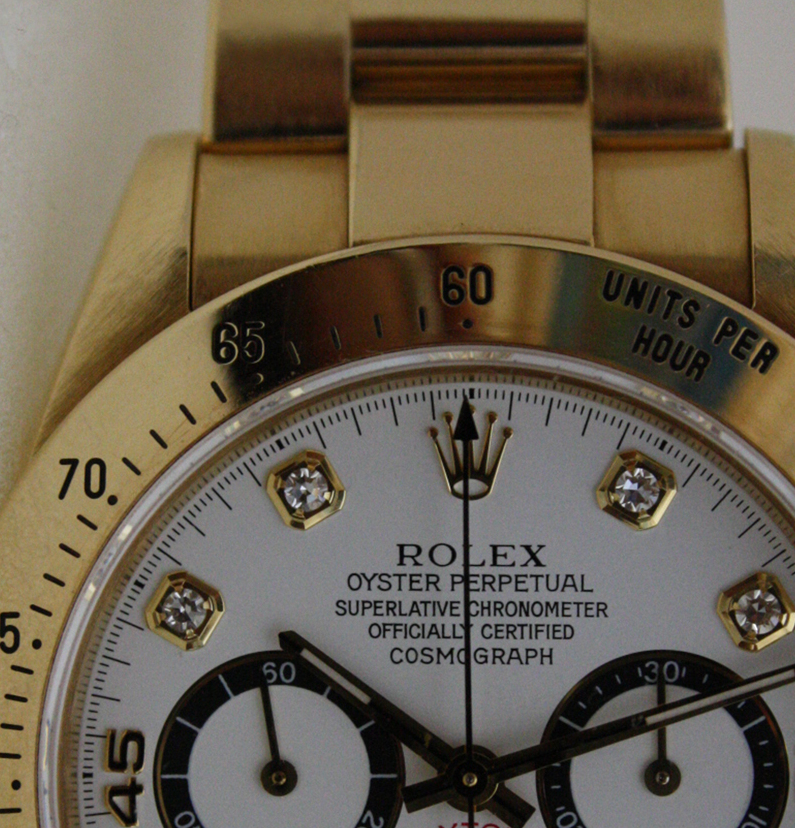
The current ref. 126500LN, introduced in 2023, wears a Cerachrom bezel insert with a tachymeter scale — the first steel Daytona to feature ceramic on the bezel. The 'inverse panda' dial configuration, with black sub-dials on a white dial, immediately became the most requested variant. Authorized dealers report waiting lists measured in years, though the exact length is a closely guarded number that Rolex itself never confirms.
The 4131 movement inside represents a meaningful upgrade: a column-wheel chronograph with vertical clutch, offering instantaneous start-stop-reset with no hand stutter. It runs at 28,800 vph with a 72-hour power reserve. Rolex has also improved the bracelet with the Oysterlock clasp and Easylink extension system. In pure horological terms, the modern Daytona is the best racing chronograph available at any price point.
But the Daytona's real power is narrative. It is the watch that nobody wanted and everybody now wants. That arc — from rejection to obsession — gives it a story that money cannot manufacture. Every collector who owns a Daytona is participating in a plot twist that has been unfolding for sixty years, and there is no indication that the final chapter has been written.